

This year my theme is: Streamline
Across everything: life, business, health, wealth, relationships...
I’ve even streamlined my work office, moving to a smaller, simpler office, removing a ton of stuff accumulated over the years.
For XEN, we’re making streamline our guiding theme. We’re applying this principle to our internal processes, our tech stack, our product and service offerings, and the engagements we have with clients.
Why Wait for AI to Force Streamlining?
Aside: One of the hidden inefficiency areas in most businesses is all the bureaucracy and outdated processes still being followed.
Whenever I see stories about how AI is reducing costs, I wonder how much of the impact is because it removes outdated processes. Often a by-product of getting rid of whole layers of people: the outdated processes go with them.
Why wait for AI to do this? Why not focus on identifying the outdated processes as soon as possible and streamlining operations?
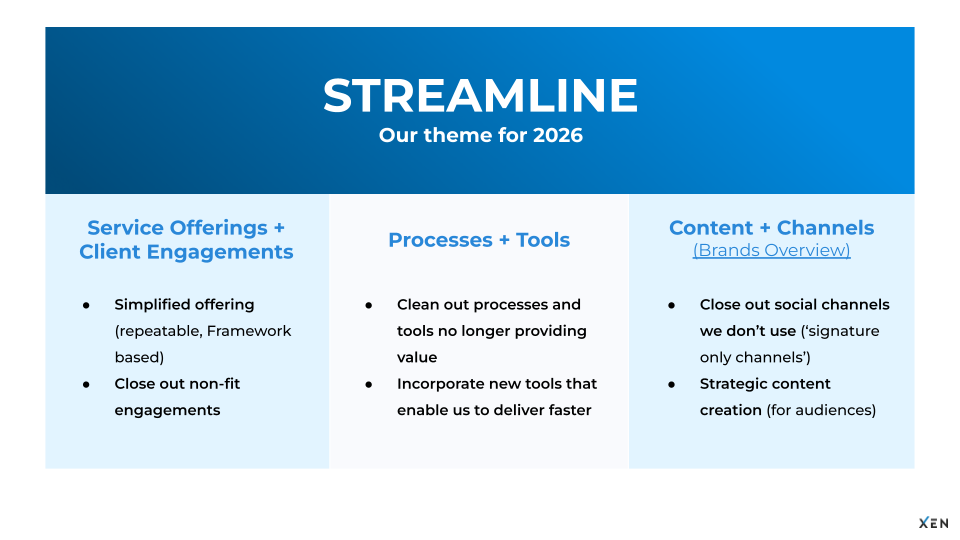
Source: slide from our internal All Staff meeting at the start of the year
Streamlining Internal Processes
Part of our onboarding process with new team members is asking them to identify how we can improve the onboarding process. Every new person brings a perspective we miss internally (‘can’t see the wood for the trees’).
A few years ago it took us two weeks to bring a new person up to speed. The first two days were getting logins and accounts in place. Seems crazy in hindsight. Last month our latest addition to the team was up and running in 30 minutes, and working on billable work within three days. And we’re working to further improve this. These are the small improvements driving significant change time after time.
Tech Stack: Reducing Cognitive Load
Like many companies, we’re using lots of platforms, lots of subscriptions, and lots of jumping between the tools to do things.
It requires careful thinking in order to streamline tools - not only to streamline the individual platforms we use, but also within those platforms, streamline down to the features we get the most value from.
So it’s less about saving money, although it is a key benefit, it’s more about saving mental cycles, making sure the way we use these tools is efficient, focused, clear.

The Longevity Principle
Streamlining when it relates to a platform or tool is best considered with how long you think you’re going to use the platform within your tech stack. There are some tools that are probably short term, disposable. You’ll likely stop using them in a couple of months or replace them with something else. Streamlining them isn’t a good use of time.
But for tools that are foundational in your tech stack - for example, HubSpot is for us - they’re worth the time and thinking to continually streamline, because we know we’re going to be using the platform for many years to come. Putting in regular time to keep it organised and streamlined pays dividends in the future.
With HubSpot we’re spending time configuring all the agents and assistants to be useful. Plus we’re maintaining all the naming conventions of workflows, lists, reports, etc, so there’s no confusion for users.
Compare this to a tool like ChatGPT which we consider disposable. Chances are we won’t be using it a year from now, since we’ll be using other AI tools. We don’t spend much time keeping it organised, since the long-term payoff likely isn’t there.
Streamlining Social Channels
A simple action: we’re streamlining our social channels. We used to have X(Twitter), Instagram, Threads, LinkedIn, YouTube, Facebook, Pinterest, etc. channels for all our brands. We’re streamlining this down to one or two key channels for each, and we’re converting the rest into ‘signature profiles’.
It may seem inconsequential (after all, why don’t we just forget about them), but mentally it’s helpful because it encourages us to focus.
What this means is we update them to be a signature that essentially says we’re no longer using this channel, but if you want to follow us, it points to where we’re available. We do this by creating the final post there or updating the profile banner or profile image to indicate we’re no longer using the channel and where to find us instead.
(Here’s a variation on the idea: my wife streamlined down her social channels, just to focus on writing. As part of the process she deleted almost all her Instagram posts, except for a few - essentially just leaving a signature of her work.)
Streamlined Service Offerings
We had various models such as on-demand, hourly engagements, subscriptions or retainers, project-based projects, packaged-up products. We’ve had quite a mix. What we’ve decided this year is to streamline that down.
XEN Consulting
On our XEN consulting side we are now mainly focused on an on-demand hourly rate. Clients buy a block of hours and we use them to provide strategy, planning, implementation, or training.
Previously we tried packaging these up (‘value pricing’) or putting them as part of a retainer, but we found this too hard to standardise. Every client wanted a different mix or needed a different set of focus for their outcomes. Packaging it didn’t provide a high-quality outcome for them, or if it did, it meant we were over-delivering.
By moving to on-demand only as our primary approach, we’ve ensured the client gets the best outcome and we get paid for the time we use.
The consideration: as we get faster at delivering, the clients get more for their dollar. They get higher value.
XEN Create
For our XEN Create brand, we used to offer a subscription plus a per-delivery option or an hourly option. We’ve streamlined this down to our design subscription and website projects based on a cost per page. This has provided the best flexibility for clients, allows them to understand the model well, and allows us to plan appropriately.
Streamlining Client Engagements
We’ve also extended this to our customer base. We’ve been fortunate in the last few years to work almost exclusively with good fit clients (compared to years ago when we had an unhelpful mix of bad fit ones as well). However, the work and engagement we had with some wasn’t ideal. It wasn’t streamlined. It didn’t facilitate them getting the best outcomes.
We’re in the process of streamlining those engagements now as well. In some cases it means reducing the quantity of work we’re doing with clients (removing the parts we aren’t expert at), in others it means being clearer about the outcomes we focus on.
By streamlining, we’re making sure the outcomes we provide for them are streamlined down to the ones where we’re experts, where we provide the most value, getting the best outcomes for clients. This might sound easy or obvious, but it’s a process of thinking we had to work through in order to arrive at the right mix.
I asked Claude to summarise all of the above, here’s what it gave me (pretty accurate I think):
Streamlining isn’t about doing less - it’s about doing what matters most, with clarity and focus.

(Image credit: XEN Create)